May 14 Update
During a follow-up review of the rate model, City staff and our consultant identified a formula error affecting calculations beginning in Year 3 of the proposed rate schedule.
The good news: after correcting the error, the updated proposed rates are lower than originally released for Years 3, 4 and 5. Click here to view the updated rates(PDF, 97KB).
---
Why Are Water Rates Being Discussed?
Water rates are being reviewed because the cost of providing water service has increased, and current revenues are no longer covering expenses.
The City is committed to maintaining a safe, reliable water system — and that requires long-term financial stability.
How Tracy’s Water System Is Funded
Tracy’s water utility operates as a self-supporting enterprise fund.
That means:
- It does not use General Fund (tax) dollars
- It must generate enough revenue to fully support its operations
Water services are funded by:
- Monthly water bills paid by customers
- Development fees paid by builders during construction
These funds pay for:
- Daily operations and maintenance
- Water treatment and distribution
- Infrastructure repairs and upgrades
- Staffing
- Public health and safety compliance
- Debt payments
- Future supply and storage planning
Why Conduct a Water Rate Study?
Cities typically review water rates every five years through a formal Water Rate Study.
The purpose of the study is to:
- Project future operating and capital costs
- Evaluate infrastructure funding needs
- Ensure compliance with legal requirements (Proposition 218 and AB 2257)
- Maintain long-term financial stability
Tracy’s current water rates were based on a study adopted in 2017, with rates implemented in 2018 and 2020.
Since then, costs and system needs have changed significantly.
What Has Changed Since 2017?
Several factors have increased the cost of providing water service:
- Rising operating expenses
- Increased regulatory requirements
- Aging infrastructure
- Increased staffing needs
- Higher material costs (such as copper and brass)
- Supply chain delays and longer delivery times
In addition, the City has identified more than $68 million in necessary water capital improvement projects that are currently deferred due to lack of funding.
Current Financial Conditions
For the fiscal year ending June 30, 2025:
- Operating Revenue: $25.2 million
- Operating Expenses: $27.5 million
This resulted in a shortfall that required the use of reserve funds.
While reserves are important for emergencies, using them to cover ongoing operating costs is not sustainable long-term.
The City is also legally required to maintain a minimum 1.20 debt coverage ratio. Without the use of reserves, the current Water Fund revenues do not meet this requirement.
Continued imbalance may impact financial flexibility and long-term credit strength.
Regional Comparison
Even under current rates, Tracy remains one of the lowest-cost water providers in the surrounding region.
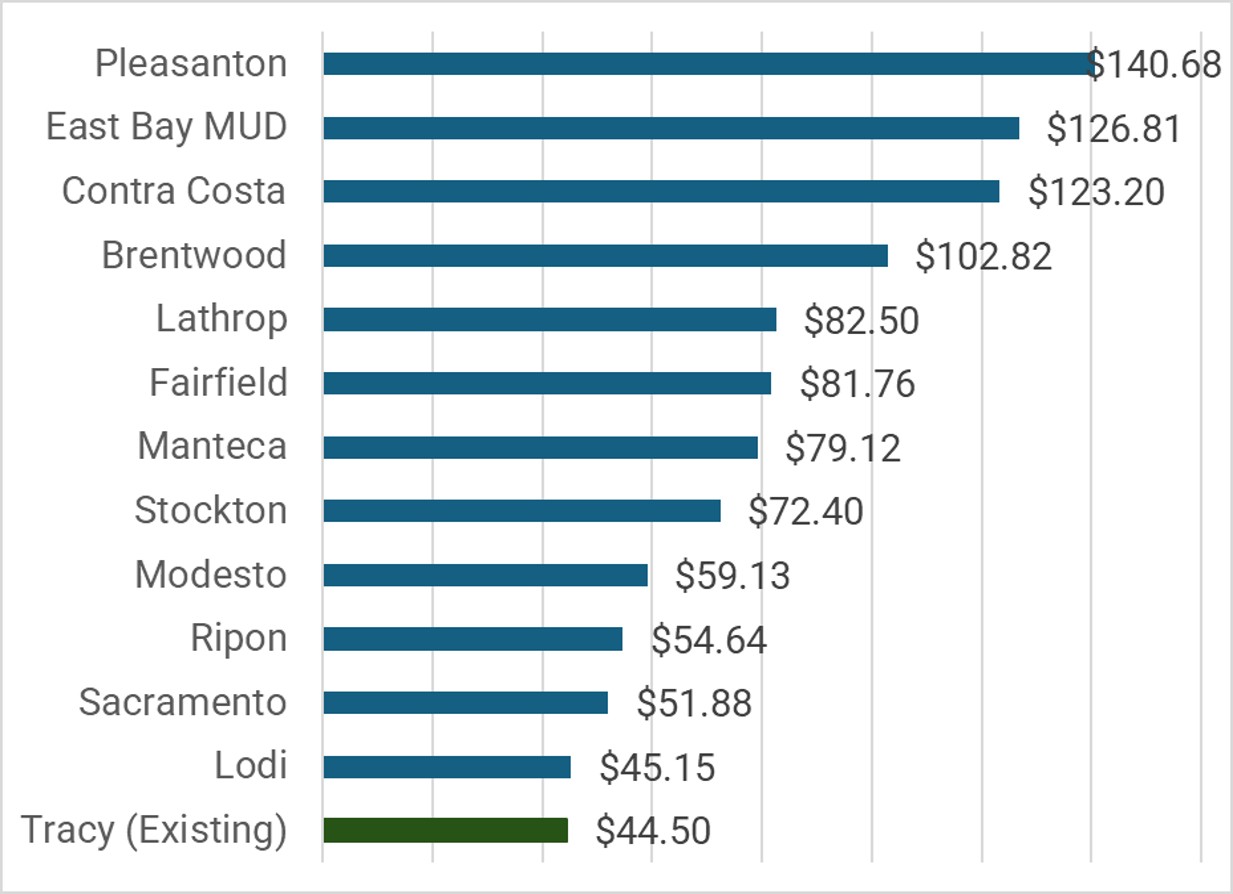
*Table is 3/4 residential meter with 16 units (HCF) used.
What Happens Next?
The Proposition 218 public notification process started on April 7th after approval by City Council. Notices began being mailed out on April 15th, to both utility bill holders and property owners. All protests are due to the City of Tracy, City Clerk's Office, 333 Civic Center Dr, Tracy, CA 95367 by 12 pm on June 2, 2026.
Staff will return to the City Council on June 2, 7:00 pm @ 333 Civic Center Plaza, Council Chambers, for a public hearing.
The City is committed to transparency and keeping residents informed throughout this process.

Updates & Resources
FAQs
Rate Study FAQs
How is the City’s Water Enterprise funded?
The City’s Water Enterprise is funded in large part by the Water rates you pay on your monthly utility bill. Your payment ensures the City’s ability to deliver high-quality, reliable Water service in a manner that values our environment and community, and sustains the resources entrusted to our care. The City of Tracy is committed to good governance, fiscal accountability, and transparency, with systems and policies in place to earn and keep the trust of our community.
Does the City’s Water Enterprise make a profit?
No. By law, a water utility cannot charge its customers more than the cost to provide the service. The City’s water system is owned by the public, its customers, and governed by the City Council; the City does not have shareholders or pay dividends.
Why is the City conducting a Water rate study?
Rate studies are conducted as an industry best practice to ensure that a City’s financial health is maintained and that the City is setting a course toward meeting future financial obligations. The industry standard is to perform comprehensive rate studies every three to five years. The last rate study was performed in 2017 with the last planned increase in 2020.
The Water Enterprise is self-funded, so its revenues must equal its expenditures. Water rates must cover the cost of service and maintain prudent reserves in case of an emergency, such as an earthquake or wildfire, which could damage major critical infrastructure like the distribution pipes that transport the Water to you the consumer. With Water rate adjustments, the City will be able to substantially increase the annual level of capital reinvestment needed to upgrade aged-out infrastructure and provide financial and operational sustainability of its Water and future recycled water services.
Why do you need to adjust Water rates now?
The City has not raised Water rates since 2020 and revenues from the current rate structure are not fiscally sustainable. Water and Wastewater services are experiencing the same global impacts of inflation. The cost for chemicals necessary to treat the Water is rising as is the parts to repair equipment. Rates must keep up with costs to operate the system. Many sections of our Water system are about 70 years old and beyond their useful life. The system needs continual repair, replacement, and upgrades to minimize the risk of blow outs, leaks, and interrupted service. Further investment ensures our Water system continues to protect public health.
Our rates are based upon the actual costs of providing Water service to you, nothing more. Rates increase when necessary to cover operating and capital costs to maintain the City’s Water system.
How are rates set?
Proposed rates are determined following evaluation and analysis of future costs related to operation and maintenance, Water treatment, capital project costs, general inflation, and material cost increases. California’s Proposition 218 requires local municipalities to follow certain procedures when proposing a rate adjustment to services such as Water. A property owner has an opportunity to protest the proposed rate increases if they feel they are unwarranted. Under Proposition 218, ratepayers will receive a public notice detailing the proposed rate adjustment, petition process, and the City Council Public Hearing date. Customers have 45 days to petition the rate adjustments through a written process. At the Public Hearing, the City Council will review customer protests to determine whether the rate adjustment will be approved. Should the City receive a majority protest from all affected parcels, the rate adjustment would not be implemented.
Is revenue from Water rates used on any non-Water projects?
No, Water Enterprise Funds can only be used on Water-related projects.
What happens if rates are not raised?
If rates are not increased, the City would continue in providing services as they happen instead of preventing them from happening. It would need to review the pressing needs of our aging systems and prioritize those that are most critical to ensure public and environmental health. Staff would be forced to defer major infrastructure projects, which would, in turn, leave our existing systems vulnerable. These investments are needed now. Deferring until later will only guarantee higher costs and possible increased regulatory oversight by permitting agencies.
What is the rate study process, and how will the community be kept informed?
The City has hired Black & Veatch, a consulting firm, with expertise in water and wastewater rate studies in California and across the country. Their scope of work includes developing long-range financial plans for Water service and assisting with the California Proposition 218 process and public hearings for rate adoption. The rate study consists of a series of steps involving data evaluation, performing technical analyses, deriving customer rates, and understanding customer impacts of any modifications. Once a rate proposal is determined, the complete study is documented in a Study Report to serve as part of the City’s administrative record.
In California, all parcels connected to a Water system must be given notice of any rate changes with the ability to protest the proposed rates. The notice details the proposed rates, the basis for calculating the proposed rates, the reason for the proposed rate increase, the details of the public hearing, and the ratepayers’ or property owners’ right to protest. After a protest period of no less than 45 days, the City Council may conduct a Public Hearing. Absent a majority protest to the rate proposal, the City Council may choose to adopt the rates as noticed.
2026 Rate Study Schedule: The anticipated schedule to complete the rate study and consider new rates is spring 2026 for proposed implementation on July 1, 2026, which is the beginning of the City’s fiscal year. We encourage the community to stay informed about the Water rate study through the City’s website at CityofTracy.org/WaterRates. Additionally, residents are encouraged to submit questions or comments to 2026waterrates@cityoftracy.org or call Public Works Department at (209) 831-6300.
What do rates pay for?
The City is committed to using industry best practices to ensure it thoughtfully plans for the future. Water rates are an investment in the City’s infrastructure today to secure its system’s future. Revenues derived from Water rates ensure the continuity of operations and reliable service delivery to nearly 100,000 people who live, work, and visit Tracy. As an example, Water rates pay for:
-
Maintenance and repair of critical infrastructure, such as pipelines and Water treatment facilities
-
Maintaining 575 miles of pipelines to ensure reliability
-
Maintaining more than 28,000 service connections
-
Replacing and repairing aging infrastructure (some pipes are over 70 years old)
-
Hiring and retaining highly skilled, qualified, and licensed staff to operate the Water system
How does my rate compare to other Water service rates in the area?
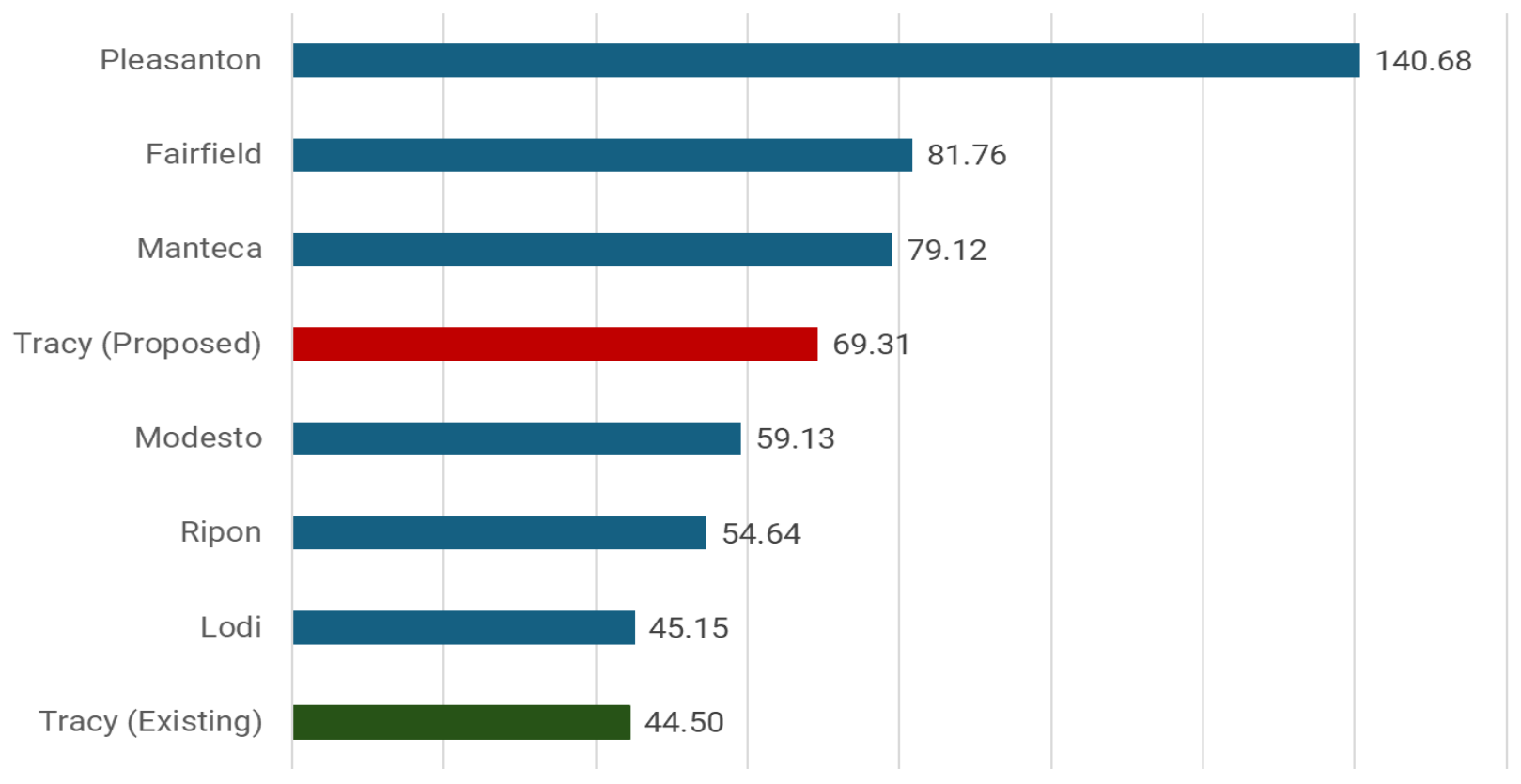
The City historically has one of the lowest rates in San Joaquin County.
How is a single-family home billed for utility service now?
You receive a monthly bill from the City for water, wastewater (sewer), solid waste and storm drain. Residential rates differ from multi-family (over five units), irrigation, industrial and commercial. More information on Utility Rates.
Current
Water charges are calculated based on a base rate water meter size fee plus the actual water consumption fee. See rates below:
Residential
|
5/8” and ¾" Meters
|
$18.50 per month
|
| 1” Meter |
$30.90 per month |
Volumetric Rate per Unit (hundred cubic feet):
| Winter Rate |
|
Units
|
Cost per Unit
|
|
0-12
|
$ 1.50
|
|
13-19
|
$ 2.00
|
|
20-40
|
$ 2.17
|
|
40+
|
$ 2.33
|
| Summer Rate |
|
Units
|
Cost per Unit
|
|
0-18
|
$ 1.50
|
|
19-29
|
$ 2.00
|
|
30-50
|
$ 2.17
|
|
50+
|
$ 2.33
|
All Others Property Types
|
5/8” and ¾" Meters
|
$18.50 per month
|
|
1” Meter
|
$30.90 per month
|
|
1½” Meters
|
$61.61 per month
|
|
2” Meter
|
$98.61 per month
|
|
3” Meters
|
$185.00 per month
|
|
4” Meter
|
$308.40 per month
|
|
6” Meters
|
$616.61 per month
|
|
8” Meter
|
$986.61 per month
|
|
10” Meters
|
$1,418 per month
|
Volumetric Rate per Unit (hundred cubic feet):
|
|
|
|
Commercial
|
$2.18
|
|
Industrial
|
$1.59
|
|
Irrigation
|
$2.40
|
|
Construction
|
$2.18
|
PROPOSED FOR FY27*
* See full report for Fiscal Year changes
|
|
|
|
1” Meter
|
$30.13 per month
|
|
1½” Meters
|
$50.16 per month
|
|
2” Meter
|
$74.20 per month
|
|
3” Meters
|
$138.32 per month
|
|
4” Meters
|
$210.45 per month
|
|
6” Meters
|
$410.80 per month
|
|
8” Meters
|
$859.62 per month
|
|
10” Meters
|
$1282.78 per month
|
Volumetric Rate per Unit (hundred cubic feet): $2.95
What are you doing to help people who can’t afford rate increases?
We recognize that affordability is an issue for our communities. For its customers, the City of Tracy offers a customer assistance program. Learn more about payment options and low-income assistance by calling the City of Tracy Finance Department at 209-831- 6800 or on our website cityoftracy.org/Departments/Finance/Utilities/Payment-Options
How do I find my assessor’s parcel number (APN)?
You may contact the San Joaquin County Office of the Assessor at 209-468-2630, visit them in person at 44 N. San Joaquin Street, Stockton, CA or view their websiteat https://sjmap.org/DistrictViewer/.
Are the proposed rates related to new development or a data center?
No, rates are established based on current infrastructure and the needs of the established system. Please review resources for more information.
Public Water System FAQs
What is a Public Water system?
A public water system is a system comprised of wells, treatment plants, holding tanks and booster stations to move water through various miles of pipes, valves, and meters to your home, school, or business. Below are just some of the necessary people, supplies, equipment, and facilities that make up Tracy’s public water system.
What do I do when there is a water issue on my property?
Property owners are responsible for maintaining their lateral line that starts behind the water meter. However, if you need water turned off to make a repair, have no water or are experiencing a water quality related issue, you will need to contact the City by using the GoTracy app, reporting at http://cityoftracy.org/gotracy or calling(209) 831-6300 during business hours. If you are experiencing an after-hours emergency, call (209)831-6550.
What is the leading cause of Water system issues?
Aging infrastructure – The City’s public water system’s average age is around 70 years old with some pipes being close to 100 years old. The older system, when it wears out creates leaks in the pipe which prevents water from moving. The City is required to isolate that section of the pipe, by turning off the water, and making necessary repairs to that section of pipe.
How do I find information about my water quality?
The City has a water quality monitoring program and inspection system that ensures safe drinking water is delivered to you and your family. The City takes on averageabout3000 samples a year, most of which are done on a weekly basis, for testing at both their own laboratory and outside State-certified laboratories. An Annual Water Quality (aka CCR) report is published before July 1stof every year. The last five years of data may be found on the City’s website here: cityoftracy.org/Departments/Public-Works/Water-Sewer-Stormwater/Water-Quality-Supply
Why does the City have a conservation program?
New laws require that all water suppliers, like the City of Tracy, reduce their daily water consumption for allitsusers. This includes indoor and outdoor water uses, as well as commercial, industrial,and institutional water uses.In order tomeet the ever-increasing mandates by the State, the City of Tracy enacts Water Stages for conservation measures. Currently, theCityis in Stage 3 of its Water Conservation Ordinance. This limits outdoor water use, such as irrigating your landscape, to the hours of 7:00 p.m. to 9:00 a.m., three days per week depending on your odd or even address. It also prohibits using water from your hose to wash off driveways, patios,and other hardscapes.
I have questions that I can't find information on. How do I contact the City?
You can email at 2026waterrates@cityoftracy.org or call Public Works Utilities at 209-831-6300